In the early 1930s, Walt Disney’s story artists started pinning every scene of a film to the wall before anyone animated a frame. You could stand in one room, see the whole picture, find the weak scene, and fix it while it was still cheap to fix.
The first factory on the Moon deserves the same wall. Launching mass there is the expensive part, and the soil is already waiting, so the argument for building with it is simple. The hard part is everything between a scoop of dirt and a part you would trust. So here is the whole line, pinned up scene by scene: what each step has to do, what can wait, and where my own work fits. It is a sketchbook, not a design, and it is meant to be argued with.
Model sheet: the Moon
Animators kept a model sheet for every character, so that whoever drew it next drew it right. Before any scene, here is how the Moon behaves.
The story room
Seven scenes. Each panel is the shot, and each card pinned beside it is the notes: what sets the requirement, what a first factory must have, and what is nice to have once the first one works. Take the red pencil to see the bare minimum.
Dig scene 1
Set by: dust, power, and knowing which soil you are standing on.
- An excavator built for abrasive dust: sealed joints, few sliding surfaces.
- A site whose soil chemistry is already mapped. Mare or highland changes every scene after this one.
- Digging and hauling on its own through the two week night.
- Picking one soil type on purpose instead of taking whatever is under the scoop.
Sort scene 2
Set by: what particle sizes the heating and forming steps can handle.
- Sieving to a size band, and throwing out rocks.
- Magnetic separation, to pull out grains rich in metallic iron.
- Blending minerals on purpose to land the mix in a target viscosity window. The stretch goal on my viscosity project, not started yet.
Check scene 3
Set by: heating only works inside a window, and the window depends on what went in.
- Size and shape of every batch, from a camera and a model instead of a lab. The SEM Powder QC idea, moved to the Moon.
- Bulk chemistry, iron above all, since it sets the processing temperatures.
- Batch to batch drift with error bars, the before and after comparison the SEM tool already reports.
- Measuring the iron’s oxidation state directly instead of assuming it.
Heat scene 4
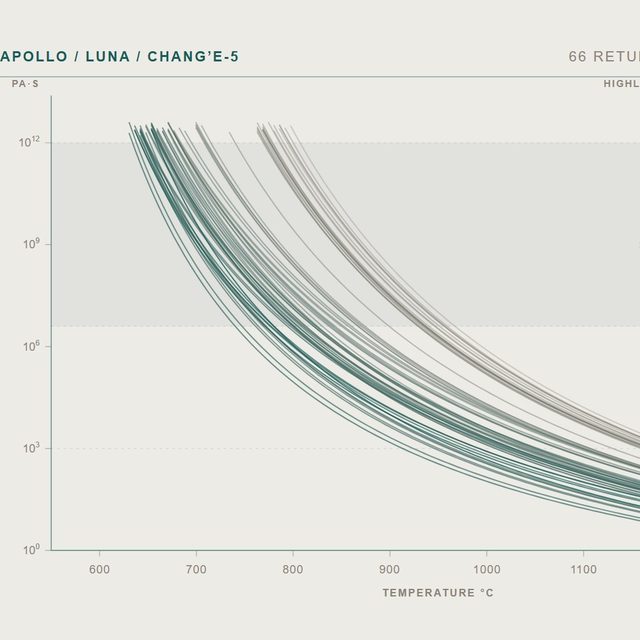
Set by: viscosity. Sintering lives between softening and the glass transition; melt processing lives above the working point.
- Process windows calibrated to lunar iron, not air melted simulants. Fully molten the difference is small; near the glass transition it is 5 to 32 K for iron rich soils, and no current model predicts it reliably.
- Temperature control tighter than the window. Near the glass transition, every 10 K is about half an order of magnitude in viscosity for a mare soil.
- The lowest peak temperature that works: less energy, more furnace materials to choose from, less wear on the hot zone.
- Sharing heat with oxygen extraction, since molten regolith electrolysis needs a melt anyway.
- Concentrated sunlight as the heat source during the day.
Shape scene 5
Set by: how fast the material stops flowing once it is placed.
- A forming method matched to the regime. For melt extrusion the bead goes down near the working point, 1,000 Pa·s, and has to reach softening, about 4,000,000 Pa·s, before the next pass.
- A soil that suits the process. Mare melts need less heat; highland melts freeze faster in vacuum. Neither is free.
- Building big parts in place, so nothing has to be carried after it is made.
Inspect scene 6
Set by: nobody is going to break every part to test it.
- A way to call a part good without a lab: dimensions from a scan, density from weight and volume.
- Watching for defects while the part is being made, the way CAMAL is working toward for electron beam printing on Earth.
- Melting rejects back into feedstock.
Meanwhile every scene
Set by: the Moon.
- Power that lasts through the two week night.
- Recovering from a jam or a fault with nobody there.
- Keeping dust out of every moving part.
- Parts a robot can swap.
Where my two projects pin in
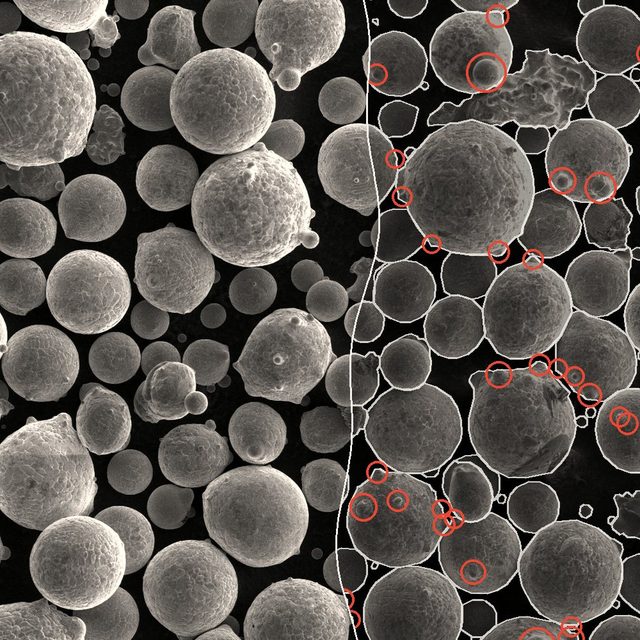
The SEM tool already does what scene 3 needs: images in, size, shape and a verdict on whether a batch changed, with error bars, no sizing instrument required. The lesson that transfers is to trust the change between batches more than any absolute number.
The viscosity work says scene 4 can use Earth data for melting and cannot for sintering, and that the gap is a missing measurement, not a missing model. Anyone sintering mare soil should want viscosity data near the glass transition on reduced iron before trusting a temperature.
Still stuck to the wall
Questions I cannot answer yet.
Big things start as drawings people pin to a wall and argue about. This is mine.
If one of these cards is a problem you are working on, or one you think I got wrong, I would like to hear it.
lacaffar@ncsu.edu