Where this page stands
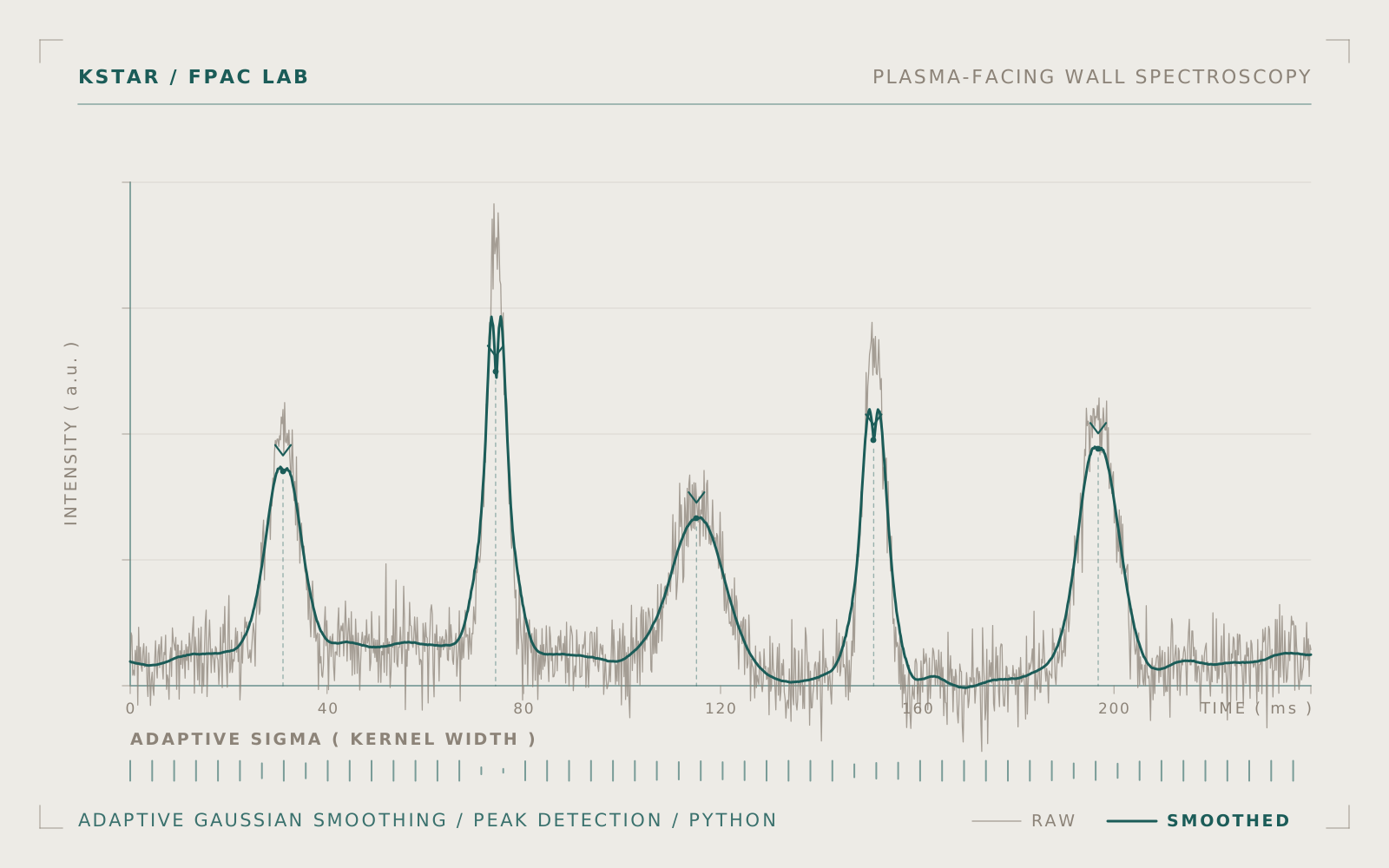
This was a semester of work a year and a half ago and I am writing it from memory and my notes. The cover plot is illustrative of the method, not a figure from the lab. If I can get clearance to show real output, it goes here.
Overview
I joined the Fusion Plasma Auxiliaries Characterization lab as a freshman and spent a semester analyzing spectroscopy and high-speed video from KSTAR fusion reactor experiments, supporting reactor wall stability assessment. KSTAR is a Korean tokamak. The plasma-facing wall has to survive heat and particle loads beyond almost anything else built, and when the plasma interacts with that wall, the evidence shows up in the light it emits.
The work
I built Python time-series processing for the diagnostic signals, including adaptive Gaussian smoothing to improve peak detection in noisy data. The kernel narrows where the signal is steep, so real emission peaks stay sharp while the flat stretches between them get properly denoised.
Still to write
- What the smoothing actually improved, with a before and after.
- The video side of the analysis, which I have barely mentioned here.
- How this connects to the reliability work I did later, which I think it does.